How Much Does It Cost to Build a Villa in Bali? A Comprehensive Breakdown
By Jaya Construction BaliJune 22, 20267 min read
In this article
Dreaming of a private sanctuary surrounded by lush tropical greenery and the gentle sound of ocean waves? For many, the vision of building a custom villa in Bali is the ultimate life goal, blending exotic living with personal design. However, turning that dream into a blueprint and, finally, into a tangible structure requires a clear understanding of the financial investment involved. The cost to build a villa in Bali is not a single, simple number; it’s a spectrum influenced by a multitude of factors, from the location of your land to the quality of your bathroom tiles. This guide provides a detailed exploration of the costs, helping you navigate the financial landscape of constructing your Balinese retreat.
Introduction: Beyond the Postcard
Bali’s allure is undeniable. Its unique culture, stunning landscapes, and relatively lower cost of living compared to many Western countries attract investors, retirees, and lifestyle seekers from around the globe. Building a villa offers unparalleled customization and, for some, a more cost-effective path than purchasing a pre-built luxury property. However, costs can escalate quickly if not meticulously planned. The final price tag is a sum of direct construction costs, professional fees, regulatory charges, and often-overlooked “soft” costs. This article will dissect these components, providing realistic figures and essential advice for prospective builders.
The Land: Your First Major Investment
Before a single brick is laid, you need land. Land cost is arguably the most variable factor and sets the baseline for your entire project budget.
Location is Everything: Prices vary dramatically across the island.
Prime Tourist Hubs (Seminyak, Canggu, Uluwatu): Premium beachfront or rice-field view plots here can cost between $150,000 to over $1,000,000 USD for just 3-10 are (300-1000 sqm). The closer to the ocean and the more developed the area, the higher the price.
Developing & Scenic Areas (Pererenan, Seseh, Tabanan): Here, you can find beautiful land for $50,000 to $200,000 USD, offering a balance of potential and relatively lower entry cost.
Rural and Inland (North Bali, Karangasem): For those seeking tranquility, prices drop significantly, potentially to $15,000 to $60,000 USD, though infrastructure and accessibility may be less developed.
Crucially, foreigners cannot own freehold land (Hak Milik) in Indonesia. The common method is to purchase a long-term leasehold (Hak Sewa), typically for 25-30 years with options to extend, or to establish a foreign-owned company (PT PMA) to hold a building rights title (Hak Guna Bangunan). Both methods involve additional legal and notary fees, usually amounting to 1-5% of the land transaction value.
The Core Construction Cost: From Foundation to Roof
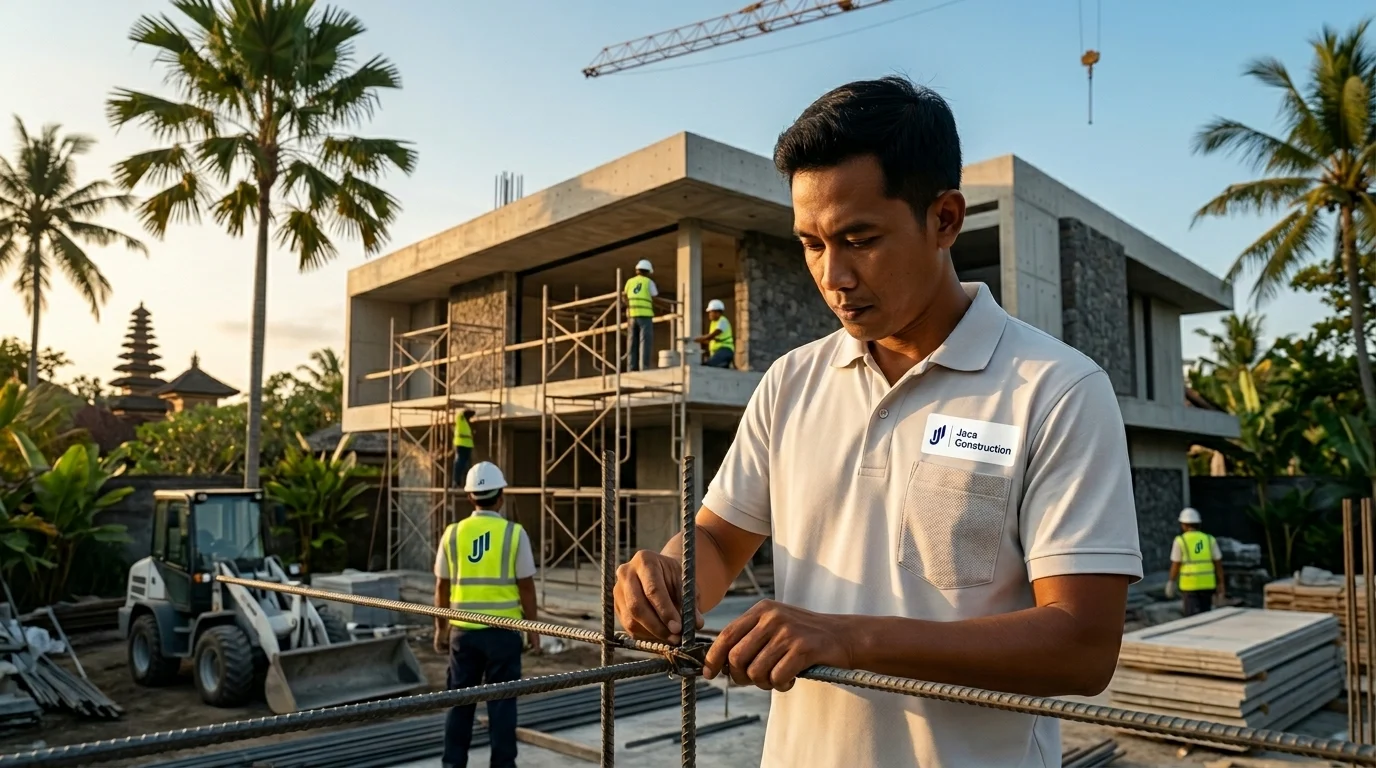
This is the physical building expense, covering materials and labor. It is often quoted per square meter. In Bali, a reasonable range for building a comfortable, standard-quality villa is $800 to $1,500 USD per square meter. For a high-end, luxury villa with imported finishes and superior craftsmanship, costs can easily rise to $1,800 to $2,500+ USD per square meter.
Let’s break down what influences this per-square-meter cost:
1. Design and Architectural Style
A simple, single-story rectangular structure will be at the lower end of the spectrum. Complex designs with multiple levels, curved walls, expansive glass windows, and open-air living spaces integrated into the natural terrain will increase both design fees and construction complexity and cost. A qualified architect will typically charge 7-15% of the total construction cost for a full design package (concept to detailed drawings).
2. Building Materials
The choice of materials is where taste and budget directly clash.
Structure: Reinforced concrete frames are standard and durable. The quality and amount of steel and concrete mix affect cost.
Roofing: Traditional alang-alang (thatch) is charming but requires replacement every few years. Modern alternatives include clay tiles or metal roofing.
Finishes:
* Flooring: Options range from affordable local ceramic tiles to polished concrete, high-end marble, or hardwood like teak.
* Walls: Can be basic plaster and paint, feature natural stone cladding, or use high-end wallpaper.
* Windows & Doors: Simple aluminum frames are budget-friendly, while custom hardwood or aluminum-clad wood frames with large sliding glass panels command a premium.
3. Labor Costs
Bali has a skilled workforce of construction workers (tukang) and foremen. Labor costs are relatively lower than in Western countries but have been rising. A competent, experienced contractor will manage a team of specialized workers. It is essential to hire a reputable contractor with a verifiable track record. Paying slightly more for a trustworthy builder who uses proper engineering, quality materials, and pays fair wages can prevent catastrophic structural issues and costly repairs later.
4. Size and Layout
A larger villa will have a higher total cost, but the per-square-meter cost might slightly decrease due to economies of scale. The number of bedrooms, bathrooms, and living areas directly impacts the total. Don’t forget to include essential service areas: a kitchen, laundry room, storage, pump room, and a generator house.
Beyond the Walls: Essential Additional Costs
Many first-time builders focus solely on construction and are shocked by the ancillary expenses. These “soft costs” can add 20-35% on top of your core construction budget.
1. Permits and Licensing
Building legally requires permits, most notably the Izin Mendirikan Bangunan (IMB), now often processed online as part of the PBG (Persetujuan Bangunan Gedung) system. Fees depend on the building size and location. You will also need an environmental permit (Izin Lingkungan) and a location permit (Izin Lokasi) if leasing through a company. Budget $2,000 to $8,000+ USD for all necessary permits, including agent and notary fees.
2. Site Preparation and Infrastructure
This can be a major hidden cost.
Land Clearing: If the plot has dense vegetation, old structures, or uneven terrain, clearing and leveling costs apply.
Access Road: A private access road may need to be built or improved.
Water: You may need to drill a deep borehole (sumur bor), which can cost $3,000 to $10,000 USD, depending on depth and location. A water filtration system is also essential.
Electricity: Connecting to the local grid (PLN) involves fees. A backup generator is non-negotiable due to power outages.
Sewage: Most villas use a septic tank system (septictank), requiring proper construction and regular maintenance.
3. Swimming Pool & Landscaping
A pool is nearly expected in a Balinese villa. A standard infinity pool can cost $15,000 to $40,000 USD or more, depending on size, shape, and filtration system. Landscaping a tropical garden with mature plants, pathways, and irrigation can range from $5,000 to $30,000+ USD.
4. Interior Furnishing and Technology
The cost to fully furnish a 3-bedroom villa—from sofas and beds to cutlery and linens—can vary wildly. A budget of $15,000 to $50,000 USD is typical for mid to high-range furnishing. Smart home systems, high-speed internet wiring, and advanced security systems add further to the cost.
5. Professional Fees
Beyond the architect, you will need:
Structural Engineer: Essential for calculating loads, especially in earthquake-prone Bali.
MEP Engineer (Mechanical, Electrical, Plumbing): For designing efficient AC, plumbing, and electrical systems.
Project Manager: If you are not resident on-site, a reliable project manager to oversee the contractor, budget, and timeline is invaluable. Their fee is usually a percentage of the project cost.
Sample Budget Scenarios
To illustrate, let’s outline two hypothetical projects:
Scenario A: Mid-Range Villa
Land: 5 are in Seseh, leasehold – $75,000
Construction: 200 sqm, @ $1,000/sqm – $200,000
Pool: Standard 8m pool – $20,000
Professional Fees & Permits: – $30,000
Furnishing & Landscaping: – $35,000
Contingency (10%): – $36,000
Total Approximate Budget:$396,000 USD
Scenario B: High-End Luxury Villa
Land: 8 are in Canggu with rice field view, leasehold – $250,000
Construction: 350 sqm, @ $2,000/sqm – $700,000
Pool: Large infinity pool with jacuzzi – $50,000
Professional Fees & Permits: – $80,000
Furnishing & Landscaping: – $120,000
Contingency (10%): – $120,000
Total Approximate Budget:$1,320,000 USD
Critical Considerations and Final Advice
The Contingency Fund is Non-Negotiable: Unforeseen issues—rocky soil, price increases for materials, design changes, bureaucratic delays—are the rule, not the exception. Always allocate a minimum of 10-15% of your total budget as a contingency fund.
Timeline: Building a standard villa typically takes 8-14 months from groundbreaking to completion. Complex projects can take longer.
Legal Structure: Consult with a reputable Indonesian lawyer and tax advisor before purchasing land or commencing any agreement. Understand the implications of your ownership structure.
Visit and Vet: Before hiring, visit villas your potential contractor has built. Speak to previous foreign clients. A strong, transparent contract with clear payment schedules tied to milestones is your best protection.
Respect the Culture and Environment: Successful building in Bali often involves respecting local traditions (such as ceremonial ground-breaking), employing local labor, and designing with environmental sensitivity (water management, minimal tree felling).
Conclusion: An Investment in Lifestyle and Legacy
Building a villa in Bali is more than a construction project; it’s an investment in a unique lifestyle and potentially a valuable asset. While the cost can range from $300,000 for a beautiful, mid-sized property to well over $1.5 million for a luxury masterpiece, meticulous planning, diligent research, and the assembly of a trustworthy professional team are the keys to staying on budget and achieving a result that matches your vision. By understanding every component of the cost—from the price of the land to the last throw pillow—you can embark on this exciting journey with financial clarity and confidence, ready to build not just a house, but a home in one of the world’s most enchanting locations.
 By Jaya Construction Bali June 22, 2026
7 min read
By Jaya Construction Bali June 22, 2026
7 min read