Building on a Slope in Bali: Structural Solutions and Essential Considerations
By Jaya Construction BaliNovember 23, 20268 min read
In this article
Bali’s dramatic, undulating landscape is one of its most cherished assets, offering stunning vistas and a sense of harmonious integration with nature. This topography, however, presents a significant engineering challenge for construction. Building on a slope in Bali is not merely an aesthetic choice but a complex structural endeavor that requires meticulous planning, innovative engineering, and a deep respect for the environment. The island’s unique combination of volcanic geology, tropical climate, and cultural ethos means that standard construction methods are often inadequate. Successful hillside development hinges on specialized solutions that ensure stability, manage water, and preserve the integrity of the land for generations to come. This article explores the essential structural strategies, materials, and philosophical approaches required for building safely and sustainably on Bali’s challenging slopes.
The Unique Challenges of Bali’s Hilly Terrain
Before delving into solutions, it is crucial to understand the specific problems that builders face. Bali’s slopes are not uniform; they vary from gentle gradients in rice terraces to steep, rocky inclines in areas like Ubud, Uluwatu, and the northern highlands. Each site presents its own set of variables.
Soil Composition and Stability: Much of Bali’s soil is volcanic residual soil, which can be highly fertile but also prone to erosion and instability when saturated. The presence of clay layers, sand, and organic matter varies greatly over short distances. A thorough geotechnical soil analysis is the non-negotiable first step. This involves boring tests to determine soil bearing capacity, composition, and the water table level. Without this data, any design is essentially a guess, risking catastrophic failure.
Hydrology and Drainage: Bali’s tropical climate brings intense, seasonal rainfall. On a slope, water is the most powerful destabilizing force. It saturates the soil, increasing its weight and reducing cohesion, leading to landslides. It also causes surface erosion, washing away topsoil and undermining foundations. Therefore, managing stormwater is not an add-on feature but the core of hillside design.
Accessibility and Logistics: Constructing on a steep site complicates the movement of materials, machinery, and labor. The logistics of excavation, foundation laying, and material transport can significantly impact the project timeline and cost. Careful planning of access routes and staging areas is essential to minimize environmental disruption and maintain efficiency.
Core Structural Solutions for Slope Stability
The structural approach to a hillside build in Bali can be distilled into a few interconnected principles: secure the building to stable ground, manage water relentlessly, and use the architecture itself to reinforce the slope.
1. Foundation Systems: The Bedrock of Safety
The choice of foundation is the most critical structural decision.
Pile Foundations: For steep slopes or areas with deep, unstable topsoil, driven or bored piles are often the best solution. Piles transfer the building’s load down to a stable bedrock or competent soil layer deep beneath the surface. This method minimizes the extent of cut-and-fill, reducing environmental disturbance and the risk of triggering slides.
Pad and Strip Footings on Terraces: On moderate slopes, the site can be terraced. The building is then constructed on a series of level platforms. Foundations must be stepped, not simply laid on a slope, with each footing resting on undisturbed, compacted soil at the terrace level. This prevents the differential settling that can crack a structure.
Retaining Wall Integration: Retaining walls are not just for holding back earth; they can be integrated into the foundation system. A well-engineered retaining wall can create a level pad for construction while also being tied into the building’s foundation to provide lateral support.
2. Water Management: The First Line of Defense
An effective drainage system works on multiple fronts to intercept, channel, and remove water.
Surface Drainage: Swales (shallow ditches), French drains (gravel-filled trenches with a perforated pipe), and properly graded slopes are used to direct rainwater away from the structure and towards designated outflows. Every roof must have well-designed gutters and downpipes connected to this system.
Subsurface Drainage: This is critical. Perforated pipes are laid in gravel beds behind retaining walls and around the foundation perimeter to collect groundwater seepage and relieve hydrostatic pressure. This network is connected to a larger drainage system, often directing water to a sedimentation tank before release to prevent clogging.
Erosion Control: During and after construction, the exposed slope must be protected. Using geotextile fabrics, coir nets, and strategic planting of deep-rooted, native vegetation helps bind the soil and reduce erosion while the landscape is re-established.
3. Retaining Structures: Holding the Hill in Place
Retaining walls are fundamental to creating usable space on a slope.
Gravity Walls: These rely on their own massive weight (using materials like stone, concrete, or interlocking blocks) to resist soil pressure. They are suitable for moderate heights.
Cantilever Walls: Made of reinforced concrete, these have an L-shaped or T-shaped profile. The weight of the soil on the heel of the base helps stabilize the wall, making them more efficient than gravity walls for taller applications.
Reinforced Earth and Geosynthetic Walls: Modern solutions involve using layers of geogrid or geotextile fabric embedded in compacted backfill, sometimes faced with decorative blocks or green walls. These are flexible, cost-effective, and can accommodate some settlement.
Natural Stone Gabion Walls: Wire cages filled with locally sourced stone offer excellent drainage, flexibility, and a natural aesthetic that blends with Bali’s environment. They are a sustainable choice when stone is readily available.
4. Architectural Design: Working with the Slope
The architecture itself should be a structural solution.
Split-Level or Stepped Design: Instead of fighting the slope with a single massive platform, the building can follow the contour, with different levels stepping down the hill. This minimizes cut-and-fill, reduces the height of any single retaining wall, and creates dynamic living spaces.
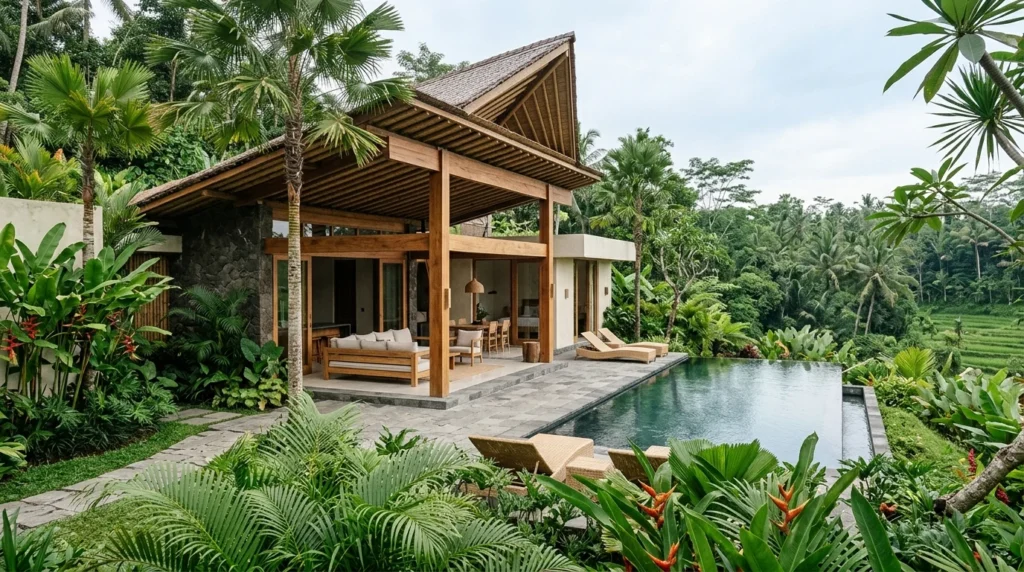
Post and Platform Construction: Using an exposed structural frame (posts) to support a platform that “hovers” above the slope is a classic and effective method. This method, seen in traditional Balinese bale (pavilions), allows natural drainage underneath and greatly reduces site disturbance.
Lightweight Materials: Opting for lighter construction materials like timber frames, bamboo, or lightweight steel can reduce the overall load on the foundations and the slope itself.
Materials and Sustainable Practices in Balinese Context
The choice of materials has both structural and environmental implications. While reinforced concrete is the backbone for most foundations and retaining walls, incorporating local and sustainable materials is not only environmentally sound but also culturally respectful and can be structurally advantageous.
Bamboo: A rapidly renewable resource, bamboo has a higher tensile strength than many steel alloys. Treated correctly (with borax solutions to prevent insect damage), it is excellent for structural frames, walls, and even lightweight roof structures. Its flexibility can be an asset in seismically active zones.
Natural Stone: Bali is rich in volcanic stone (paras and batu candi). Used for walls, terraces, and foundations, it is durable, beautiful, and has excellent thermal mass. Its use promotes a seamless visual integration with the landscape.
Recycled and Local Materials: Using reclaimed wood, recycled aggregate in concrete, and locally fired bricks reduces the carbon footprint associated with transporting materials up steep, difficult roads.
Sustainable practice also extends to the construction process. Erosion and sediment control plans must be implemented. Preserving existing trees and vegetation wherever possible is vital, as their root systems provide unparalleled soil stabilization. Replanting with native species after construction completes the cycle of ecological integrity.
Navigating Regulations and Professional Expertise
Building on a slope in Bali is not a DIY endeavor. It requires a team of qualified professionals.
Regulations: Adherence to local (Banjar), regional, and national building codes is mandatory. These codes often include specific requirements for hillside development, such as maximum slope cut angles, mandatory setback distances from ridges and valleys, and drainage specifications. Environmental impact assessments may be required for larger projects.
The Essential Team:
Structural Engineer: Indispensable for designing the foundations, retaining walls, and overall structural system. They must be experienced in geotechnical challenges.
Geotechnical Engineer: Conducts the soil analysis and provides recommendations for foundation design and slope stabilization.
Architect with Slope Experience: An architect who understands how to design with the slope, not just on it, can create buildings that are safer, more cost-effective, and more beautiful.
Specialized Contractor: The construction team must have proven experience in hillside projects. Skilled labor in precise excavation, formwork for complex foundations, and drainage installation is critical.
Conclusion: Building with Respect and Resilience
Building on a slope in Bali is a dialogue between human ambition and natural forces. It is a process that demands humility, knowledge, and investment in doing things right. The consequences of cutting corners—landslides, structural failure, erosion, and environmental degradation—are severe and long-lasting.
The successful approach synthesizes advanced engineering with traditional wisdom. It prioritizes thorough geotechnical analysis as the foundation of all design. It implements a comprehensive, layered water management strategy as a non-negotiable element. It employs robust, carefully designed retaining systems and foundations tailored to the specific site conditions. Finally, it embraces an architectural philosophy that integrates with the land, using sustainable materials and minimizing disturbance.
Ultimately, the goal is to create structures that are not merely on the slope but of it—safe, resilient, and harmonious additions to Bali’s magnificent landscape. By respecting the land’s inherent challenges and leveraging intelligent, sustainable solutions, developers and homeowners can achieve their vision without compromising the stability or beauty of the island for future generations. The most successful hillside buildings in Bali are those that appear as if the hill itself has welcomed them, a testament to the power of combining engineering prowess with environmental stewardship.

 By Jaya Construction Bali November 23, 2026
8 min read