Sustainable Sanctuaries: The Principles and Practice of Eco-Friendly Villa Design in Bali
By Jaya Construction BaliSeptember 22, 20267 min read
In this article
Bali, the famed “Island of the Gods,” has long been a destination that captivates with its dramatic landscapes, rich spiritual culture, and legendary hospitality. In recent decades, its tourism industry has boomed, bringing economic opportunity but also significant environmental pressure. In response, a thoughtful and growing movement is redefining luxury accommodation on the island: the rise of eco-friendly villa design. This is not merely a trend of adding solar panels or banning plastic straws; it is a profound philosophical and practical approach to building that seeks harmony with Bali’s unique environment, culture, and future. It represents a commitment to creating sanctuaries that rejuvenate not just their guests, but the very land and community upon which they stand.
The Core Philosophy: Designing with, Not Against, Nature
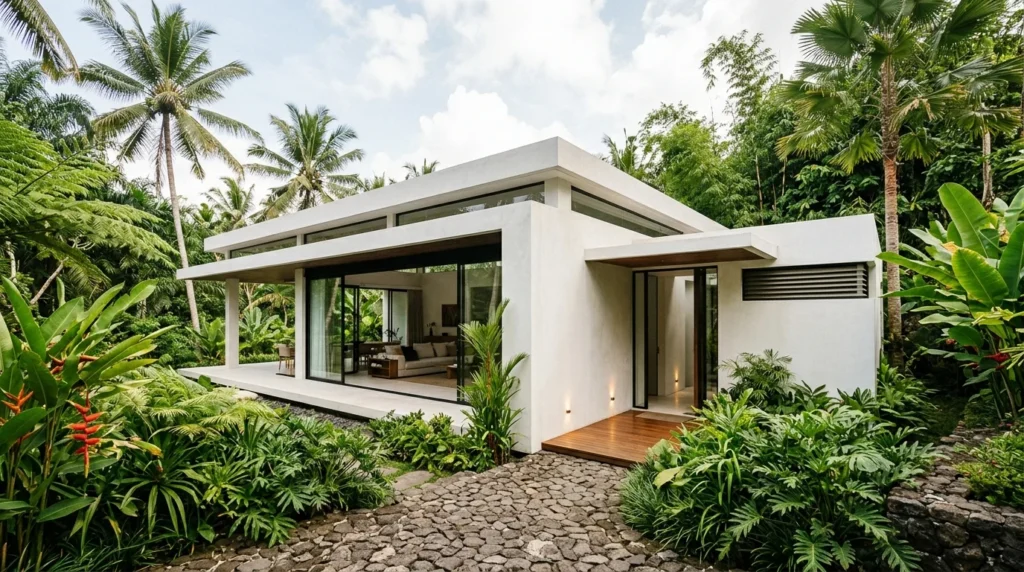
At the heart of Balinese eco-villa design lies a fundamental shift in perspective. Instead of imposing a generic, climate-controlled box onto the landscape, architects and developers are embracing biophilic design and local wisdom. The goal is to create structures that breathe, adapt, and contribute positively to their ecosystem. This philosophy is deeply rooted in the Balinese Hindu concept of Tri Hita Karana, which emphasizes harmony with God, with other people, and with nature. An eco-friendly villa, therefore, is a physical manifestation of this triad, designed to foster spiritual well-being for guests, support the local community (banjar), and tread lightly on the earth.
This approach prioritizes site-specific responsiveness over cookie-cutter solutions. Before a single line is drawn, the design considers the microclimate: the path of the sun, prevailing winds, rain patterns, and the existing topography. The villa is often positioned to minimize land clearing, preserve mature trees, and work with natural slopes rather than against them. The result is a home that feels intrinsically connected to its place, as if it has grown organically from the land itself.
Passive Design and Climate-Responsive Architecture
Bali’s tropical climate presents both a challenge and an opportunity. The key is to harness natural elements for comfort, drastically reducing the need for energy-intensive air conditioning. Passive design strategies are the cornerstone of this effort.
Maximizing Natural Ventilation: Traditional Balinese architecture offers timeless lessons. Open-plan layouts, soaring ceilings, and strategic openings create cross-ventilation, allowing constant air movement. The bale (open-sided pavilion) concept is frequently reinterpreted, with living spaces flowing seamlessly to outdoor terraces and gardens. Louvered walls, perforated screens, and pivoting wooden panels allow inhabitants to control airflow and privacy.
Mastering Solar Geometry: Careful orientation is critical. Buildings are often elongated along the east-west axis to minimize direct sun exposure on the large east and west facades, which receive the harshest morning and afternoon sun. Deep, wrap-around eaves and pergolas (often supporting climbing plants) provide shade to walls and windows, while still admitting soft, indirect light.
Thermal Mass and Cooling: The use of materials with high thermal mass, such as rammed earth or stone, can help absorb heat during the day and release it slowly at night when temperatures drop. Strategic placement of water features—reflecting pools, streams, and fountains—provides evaporative cooling, further moderating the microclimate around the villa.
Material Honesty and Sustainable Sourcing
The materials chosen for an eco-friendly villa tell a story of environmental and social responsibility. There is a conscious move away from imported, carbon-intensive materials like concrete and steel, and a renaissance in the use of local, renewable, and reclaimed resources.
Bamboo as a Supermaterial: Bali is at the forefront of the global bamboo construction movement. Engineered bamboo is incredibly strong, flexible, and sustainable, growing to harvestable maturity in just a few years. It is used for everything from structural frames and flooring to intricate furniture and decorative elements. Its aesthetic is unmistakably tropical and elegant.
Reclaimed and Certified Wood: To combat deforestation, responsible projects use reclaimed timber from old buildings, fallen trees, or certified sustainable plantations. Hardwoods like ulin (ironwood), which is naturally resistant to rot and insects, are sourced carefully for decks, structural beams, and furnishings. This practice gives new life to old materials and preserves virgin forests.
Local Stone and Earth: Volcanic stone (paras) and river rock are used extensively for walls, pathways, and landscaping, blending the villa seamlessly into its geological context. Techniques like rammed earth and adobe bricks, made from local soil and natural stabilizers, are experiencing a resurgence, creating beautiful, well-insulated walls with a minimal carbon footprint.
Non-Toxic Finishes: Inside and out, the focus is on health. Natural plasters, lime washes, and plant-based oils and stains are used instead of volatile organic compound (VOC)-laden paints and synthetic sealants, ensuring superior indoor air quality.
Closed-Loop Systems: Water and Energy Autonomy
True sustainability requires managing resources in a self-sufficient cycle. Eco-villas in Bali are increasingly designed as closed-loop systems for water and energy.
Water Stewardship: Given the island’s seasonal water stress, water management is paramount. Villas incorporate comprehensive systems: rainwater harvesting captures monsoon rains in large storage tanks for non-potable use; greywater from showers and sinks is filtered through biological systems (like constructed wetlands or reed beds) and reused for irrigation; and blackwater is processed in advanced, non-polluting bio-digesters or septic systems that produce clean effluent for sub-surface irrigation. These systems drastically reduce demand on the local aquifer.
Renewable Energy Integration: While grid-connected solar is common, leading projects aim for energy neutrality or even positivity. Roof-integrated photovoltaic panels are designed to be aesthetically pleasing, powering the villa’s needs and feeding excess back to the grid. Some incorporate small-scale wind turbines or micro-hydro if the site has a stream. Energy efficiency is ensured through LED lighting, solar water heating, and the aforementioned passive cooling, which minimizes the electrical load from air conditioning.
Waste as a Resource: Organic waste from the kitchen and gardens is composted on-site, creating nutrient-rich fertilizer for the villa’s edible gardens and landscaping. This “closed-loop” approach transforms waste from a problem into a valuable asset for food production and soil health.
Biophilic Design and Ecological Landscaping
The boundary between the built environment and the natural world is intentionally blurred. Biophilic design, which connects occupants to nature, is central to the experience and ecological function of the villa.
Living Architecture: Green roofs and vertical gardens insulate buildings, manage stormwater, reduce the urban heat island effect, and provide habitat for pollinators. They transform the villa into a living entity that cleans the air and adds lush beauty.
Native and Edible Landscaping: Landscaping eschews ornamental monocultures for biodiverse, climate-appropriate plantings. Native trees, shrubs, and flowers support local insects and birds, while integrated edible gardens—growing tropical fruits, vegetables, and herbs—provide guests with a farm-to-table experience and enhance food security. The traditional Balinese subak system of water management for rice terraces often inspires the design of landscape water features.
Habitat Creation: Ponds, insect hotels, and preserved patches of forest are incorporated to support local wildlife. The goal is not just to build on the land, but to actively participate in the regeneration of the local ecosystem, increasing its biodiversity and resilience.
The Human Element: Community and Craftsmanship
An eco-friendly villa’s sustainability extends beyond environmental metrics to its social and economic impact. The most ethical projects are deeply integrated with the local community.
Empowering Local Artisans: By commissioning local carpenters, stone masons, weavers, and artists, the project preserves and revitalizes traditional Balinese craftsmanship. Skills are passed down, and the economic benefits flow directly to families in the banjar. The villa’s unique character is then a direct reflection of the community’s talent and culture.
Sustainable Operations: The commitment continues post-construction. This includes hiring and training staff from surrounding villages, sourcing food from local farmers and fishermen, and organizing community initiatives for waste management or environmental education. The villa becomes a catalyst for positive community development.
Cultural Respect and Sensitivity: Design is undertaken with profound respect for local customs, sacred sites, and spatial planning (Asta Kosala Kosali, the Balinese architectural principles). A thoughtful dialogue with community leaders ensures the project is a welcome addition, not an intrusive force.
Conclusion: A Blueprint for Responsible Luxury
Eco-friendly villa design in Bali is far more than a checklist of green features. It is a holistic philosophy that redefines luxury as an experience of deep connection—to place, culture, community, and self. It proves that opulence and responsibility are not mutually exclusive; in fact, they are enhanced when combined. The cool, spacious interiors crafted from bamboo and reclaimed wood, the sound of water gently recycling in the garden, the taste of fruit picked from your own landscape, and the knowledge that your stay supports the preservation of this magical island—this is the new paradigm of indulgence.
These sustainable sanctuaries offer a powerful blueprint for the future of tourism worldwide. They demonstrate that development, when guided by respect, intelligence, and a commitment to circular principles, can be restorative. As more travelers seek meaning and connection in their journeys, and as the urgency of environmental stewardship grows, Bali’s eco-villas stand as beautiful, livable testaments to the possibility of a world where our homes and our habitats can thrive together. They are not just places to stay; they are experiences in mindfulness, designed to leave both the guest and the island feeling richer.
 By Jaya Construction Bali September 22, 2026
7 min read
By Jaya Construction Bali September 22, 2026
7 min read